

What Is an AI Life Assistant—and What Can It Actually Do?
AI is moving beyond chat. Here’s what an AI life assistant can realistically help you organize—and why context, privacy, and human control matter.
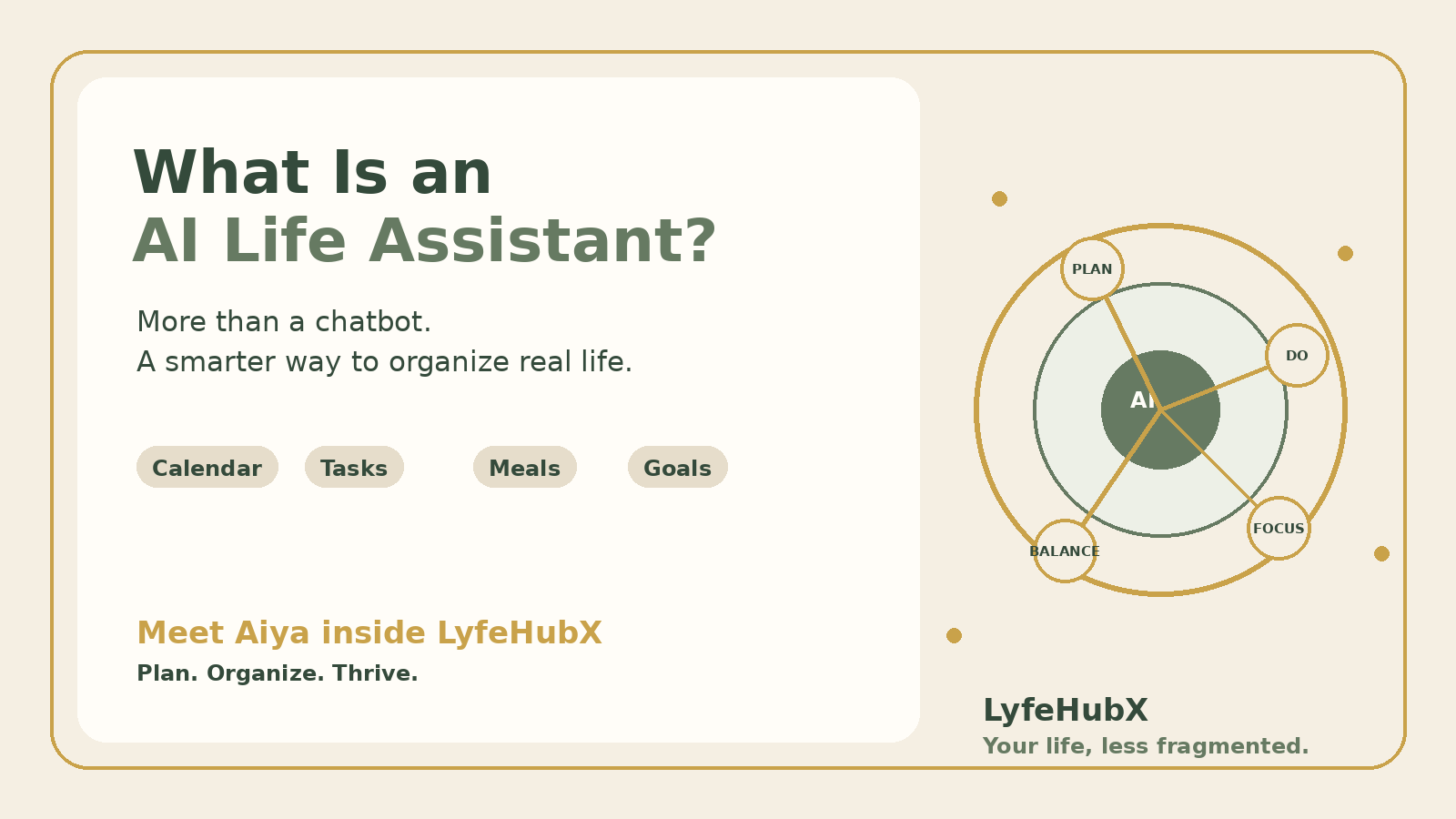
# What Is an AI Life Assistant—and What Can It Actually Do?
You’ve probably used AI to write an email, answer a question, summarize something, brainstorm an idea, or help you get unstuck.
But what if AI could help with something bigger than a single question?
What if you had an assistant that could work with the context of your life—your plans, tasks, schedule, routines, and priorities—and help turn all of that information into actual next steps?
That is the idea behind an AI life assistant.
And the distinction matters, because most people don't need more information.
They need help figuring out what to do with everything they already have going on.
So, What Exactly Is an AI Life Assistant?
An AI life assistant is an AI-powered system designed to help you organize, plan, prioritize, and manage different areas of everyday life.
Think about an ordinary Tuesday:
- Work meetings
- School deadlines
- Kids' activities
- Appointments
- Bills
- Groceries
- Meal planning
- Exercise
- Household chores
- Personal goals
- Errands
- Travel plans
- Family commitments
- And the random thing you remembered at 11:47 p.m. that absolutely cannot be forgotten tomorrow
Your calendar handles appointments. Your task app handles to-dos. Your notes app stores information. Your grocery list handles groceries. Your budgeting app handles money.
And your brain somehow gets stuck coordinating all of them.
An AI life assistant is designed to help reduce that coordination burden.
The goal isn't necessarily to replace every app overnight. It's to reduce the amount of mental energy you spend managing the management.
AI Chatbot vs. AI Life Assistant: What's the Difference?
A general AI chatbot is usually something you open when you have a question or request.
You might ask:
> "Give me five healthy dinner ideas."
And it gives you five ideas.
That's useful.
But an AI life assistant can potentially take the request further.
Instead of asking:
"Give me five dinner ideas."
You might say:
"Plan five dinners for this week around my schedule."
Depending on the system, its integrations, and the permissions you've granted, it may be able to consider relevant planning information and help turn that request into a plan.
That's the difference between answering and assisting.
A useful AI life assistant generally needs three things:
1. Context
It needs relevant information about what you're trying to accomplish.
2. Continuity
It should be able to work with plans and information over time rather than treating every interaction as completely disconnected.
3. Action
When the system has the appropriate capabilities and permissions, it can help turn decisions into something concrete—such as creating a task, organizing a schedule, building a plan, or adding something to a list.
Together, those pieces can make AI much more useful in everyday life.
What Can an AI Life Assistant Actually Do?
The answer depends on the specific system, its integrations, and the permissions you give it.
But there are several areas where an AI life assistant can become genuinely useful.
1. Help Organize Your Calendar
A calendar tells you what is happening.
An assistant can help you think through how to manage everything that is happening.
For example:
"I have two work meetings, school pickup, an appointment, and a project deadline tomorrow. Help me figure out my day."
An AI assistant can help identify conflicts, suggest priorities, organize tasks around available time, and turn a messy day into a more realistic plan.
That becomes especially valuable when personal and professional responsibilities live in the same day.
2. Turn Big Goals Into Smaller Tasks
"I need to get organized" isn't really a task.
It's a feeling.
A useful assistant can help turn a vague goal into concrete next steps.
Goal: Prepare for a family trip.
That might become:
- Confirm travel dates
- Check transportation
- Book accommodation
- Make packing lists
- Plan meals
- Check important documents
- Create a travel itinerary
- Add reservations to the calendar
3. Manage Routines and Habits
Life isn't only about appointments.
Much of what keeps a household, business, school schedule, or personal routine moving happens repeatedly:
- Morning routines
- Workouts
- Study sessions
- Cleaning
- Meal preparation
- Bedtime
- Weekly planning
And when life changes, the system should be flexible enough to change with it.
A missed workout doesn't mean you've failed.
A chaotic week doesn't mean your routine is broken.
Sometimes the routine simply needs to be redesigned for the life you're actually living.
4. Make Meal Planning Easier
Meal planning sounds simple until you actually have to coordinate it.
First you have to decide:
What are we eating?
Then:
What ingredients do we need?
Then:
What do we already have?
Then:
When are we actually home long enough to cook?
A life assistant can help connect those decisions.
For example:
"We're busy Monday and Wednesday, I want leftovers Tuesday, and I have more time to cook Thursday. Help me plan dinners and groceries."
That's more useful than receiving a random list of recipes.
The assistant is helping plan around your actual life.
5. Coordinate Family Life
Families add another layer of complexity.
Multiple schedules, school events, appointments, activities, chores, meals, deadlines, and last-minute changes can quickly become a full-time coordination job.
You might say:
"The kids have soccer Tuesday and Thursday, I have a late meeting Wednesday, and we need groceries. Help me figure out this week."
The goal isn't for AI to make every family decision.
It's to help you see the whole picture.
And that matters because the person who remembers everything often becomes the person everyone depends on.
Good systems can make that invisible work more visible—and more shareable.
6. Support School, Work, and Business
Students, employees, entrepreneurs, and business owners have something in common:
There are usually more deadlines, projects, and responsibilities than anyone wants to keep in their head.
An AI life assistant can help turn a large objective into smaller milestones.
Instead of:
"Finish research project."
You might have:
- Choose topic
- Research sources
- Create outline
- Draft introduction
- Complete first section
- Review
- Edit
- Submit
7. Help You Prioritize
This may be one of the most valuable uses of an AI life assistant.
Because sometimes the problem isn't that you have too much to do.
It's that everything feels equally important.
You might have twenty tasks staring at you.
But they aren't actually twenty priorities.
A good assistant can help you ask:
- What is urgent?
- What has a deadline?
- What affects other people?
- What will take the most time?
- What can wait?
- What can be delegated?
- What can be deleted entirely?
Sometimes the best productivity system isn't helping you do more.
It's helping you realize you don't need to do something at all.
The Real Magic Is Context
Here's where AI life assistants become especially interesting.
Imagine saying:
"I'm exhausted. Help me figure out what needs to happen tomorrow."
A generic chatbot can give you general productivity advice.
A life assistant with appropriate access to your schedule and planning information could potentially help you work from the commitments already on your calendar and organize the day around them.
That's context.
And context is what turns generic advice into personalized assistance.
But context also creates responsibility.
The more an AI system knows about your life, the more important privacy, permissions, security, transparency, and human control become.
That's not a minor detail.
It's foundational.
AI Should Assist You—Not Take Over Your Life
An AI life assistant shouldn't become the person making every important decision for you.
There are things AI can help organize.
There are things it can suggest.
And there are things that should remain firmly in human hands.
The National Institute of Standards and Technology (NIST) emphasizes trustworthy AI characteristics including validity and reliability, safety, security, transparency, explainability, privacy, and accountability. Its AI Risk Management Framework also addresses the importance of clearly defining human roles and responsibilities when people interact with AI systems.
That principle makes sense in everyday life, too.
Your assistant might suggest moving something.
You decide whether that suggestion makes sense.
It might help compare options.
You make the decision.
It might organize your week.
You remain in control of your priorities.
AI should reduce mental load—not remove human judgment.
What About Privacy?
This is one of the first questions you should ask before connecting an AI system to your personal life.
And you should.
An assistant that knows your calendar, routines, family plans, goals, or financial information needs to be treated very differently from a tool you use to generate a birthday caption.
Before using an AI-powered life tool, ask:
- What information does it collect?
- Why does it need that information?
- What permissions am I granting?
- Can I disconnect integrations?
- Can I control what the assistant can access?
- What happens to my data?
- Can I delete my account and associated information?
- Which actions require my approval?
- Can I understand what the system is doing?
They're good digital-hygiene questions.
And one principle is worth remembering:
Don't give an AI system access to something just because it can technically connect to it.
Give it the access it actually needs to provide the service you want.
Meet Aiya: The AI Life Assistant Inside LyfeHubX
This is the idea behind Aiya, the AI assistant inside LyfeHubX.
Aiya isn't designed to be another chatbot sitting in its own little corner of your phone.
The idea is to connect AI assistance to the things you're already trying to manage.
Your calendar.
Your tasks.
Your routines.
Your meals.
Your groceries.
Your goals.
Your family organization.
Your plans.
Your everyday responsibilities.
For example, instead of opening several different apps and trying to coordinate everything yourself, you could ask Aiya:
"Help me organize my week around my appointments and everything I need to get done."
Or:
"I have a busy week. Help me plan dinners and groceries around my schedule."
Or:
"Break this project into manageable tasks and help me put them into my plan."
The point isn't that Aiya magically knows everything or makes every decision for you.
The point is that your AI assistant can work alongside the organizational system you're already using.
That's a very different vision from simply asking a chatbot a question.
You Don't Need AI for Everything
Here's something that gets lost in the AI hype:
You don't need AI to run your entire life.
Sometimes you need a calendar.
Sometimes you need a checklist.
Sometimes you need to sit down with a coffee and figure things out yourself.
And sometimes you need an AI assistant to look at the chaos and say:
"Okay. Here's where we start."
The best technology should make life feel simpler—not make you feel like you need another complicated system to manage.
Try This With Your AI Assistant
If you already use an AI assistant, try giving it a real-life problem instead of asking a generic question.
Try:
"Look at everything I have going on this week and help me figure out what needs my attention first. Separate urgent tasks from things that can wait, and suggest a realistic plan."
Then evaluate the answer.
Does it understand your priorities?
Did it miss something important?
Did it create an unrealistic schedule?
What would you change?
That's the right relationship with AI:
Let it help you think. Don't stop thinking for yourself.
The Future Isn't Another App. It's Less Fragmentation.
For years, we've solved life's complexity by downloading another app.
A calendar for this.
A planner for that.
A grocery list over here.
A budget over there.
A habit tracker somewhere else.
A family communication tool.
A meal planner.
A project-management app.
Eventually, the tools designed to simplify life can become another source of mental clutter.
The bigger opportunity for AI isn't necessarily creating more places to put information.
It's creating systems that can help connect the information we already manage.
That's what an AI life assistant is really about.
Not doing everything for you.
Not replacing your judgment.
Not making your life more complicated with another dashboard.
Helping you spend less time organizing your life—and more time actually living it.
And that is the idea behind LyfeHubX.
One place to plan, organize, and thrive, with Aiya helping turn the things in your head into a clearer, more manageable plan.
Because your life is already complicated enough.
Your tools shouldn't be.
Ready to See What an AI Life Assistant Could Do for You?
Explore LyfeHubX and meet Aiya, your AI life assistant designed to help bring your calendar, tasks, routines, family organization, meals, goals, and everyday planning into one connected system.
Plan. Organize. Thrive.
---
Sources & Further Reading
- National Institute of Standards and Technology (NIST) — AI Risk Management Framework, including guidance on trustworthy, privacy-enhanced, transparent, secure, and accountable AI.
- NIST AI RMF — Human-AI Interaction, including guidance on defining human roles and responsibilities when people interact with AI systems.
- NIST AI RMF FAQs — overview of AI trustworthiness characteristics and risk-management considerations.
Get more tips like this ✨
Subscribe to our newsletter for weekly productivity tips, family organization hacks, and life-simplifying insights.
Comments
No comments yet. Be the first to share your thoughts!